 01
01Cross the threshold
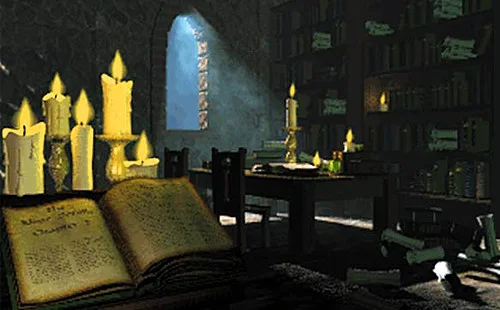
A red-lit opening establishes intimacy and threat before the ordinary rooms are allowed to look safe.

THE HOUSE ALREADY KNOWS HIM
Contains psychological horror and unsettling themes. Viewer discretion is advised.Archive story · Psychological horror
Return to ordinary rooms that seem to belong to someone else now, and decide how much familiarity a home can lose before it becomes a warning.

















House file · 01
Home Is Where He Is is a compact browser horror game that turns domestic recognition into a source of doubt. Its rooms are bright enough to understand at a glance: a kitchen counter, a made bed, framed pictures, dining chairs, and the everyday clutter that normally proves a place has been lived in. Yet the longer these spaces remain on screen, the less neutral they feel. The house appears to know a version of life that the player has not agreed to, and one quiet figure occupies that version with unnerving ease.
This page brings the playable edition together with verified game images, two videos, practical browser help, a spoiler-light reading guide, and an original long-form introduction. The interface keeps the sandstone archive character of Temple of the Jackal, while the game contributes its own red, black, and overexposed domestic palette. The result is a separate room within the archive rather than a copy of the source website.
01A red-lit opening establishes intimacy and threat before the ordinary rooms are allowed to look safe.
 02
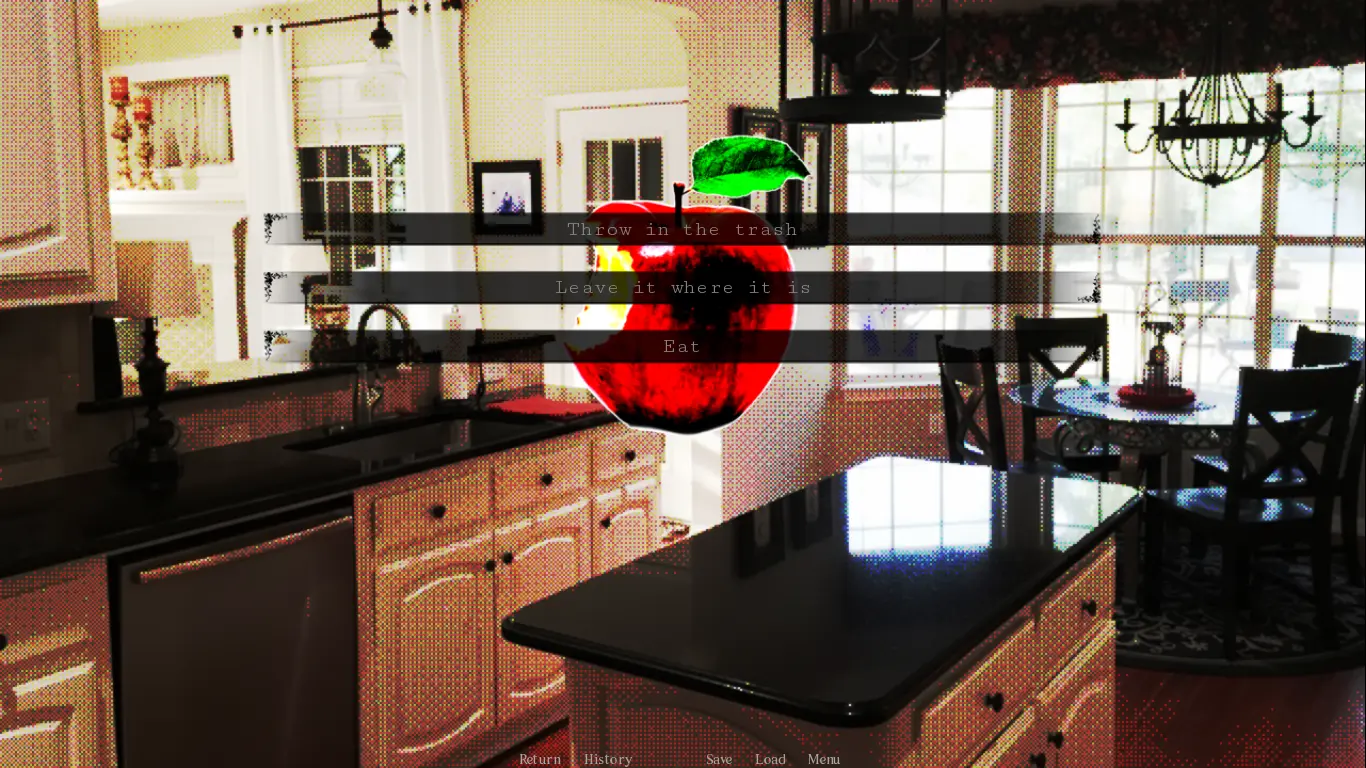
02Familiar objects become decisions. Notice what the scene asks you to accept before selecting a response.
 03
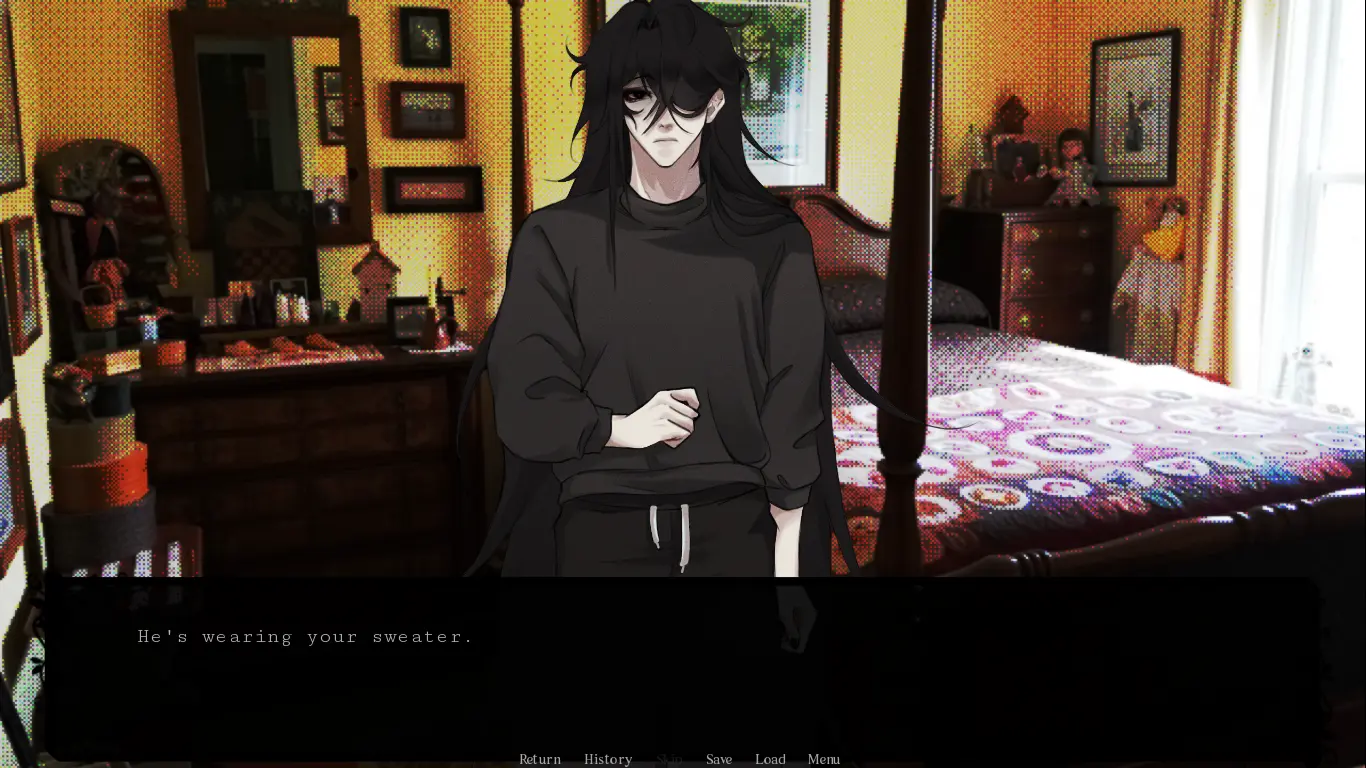
03A borrowed sweater and a comfortable pose can make possession feel more disturbing than an open threat.
 04
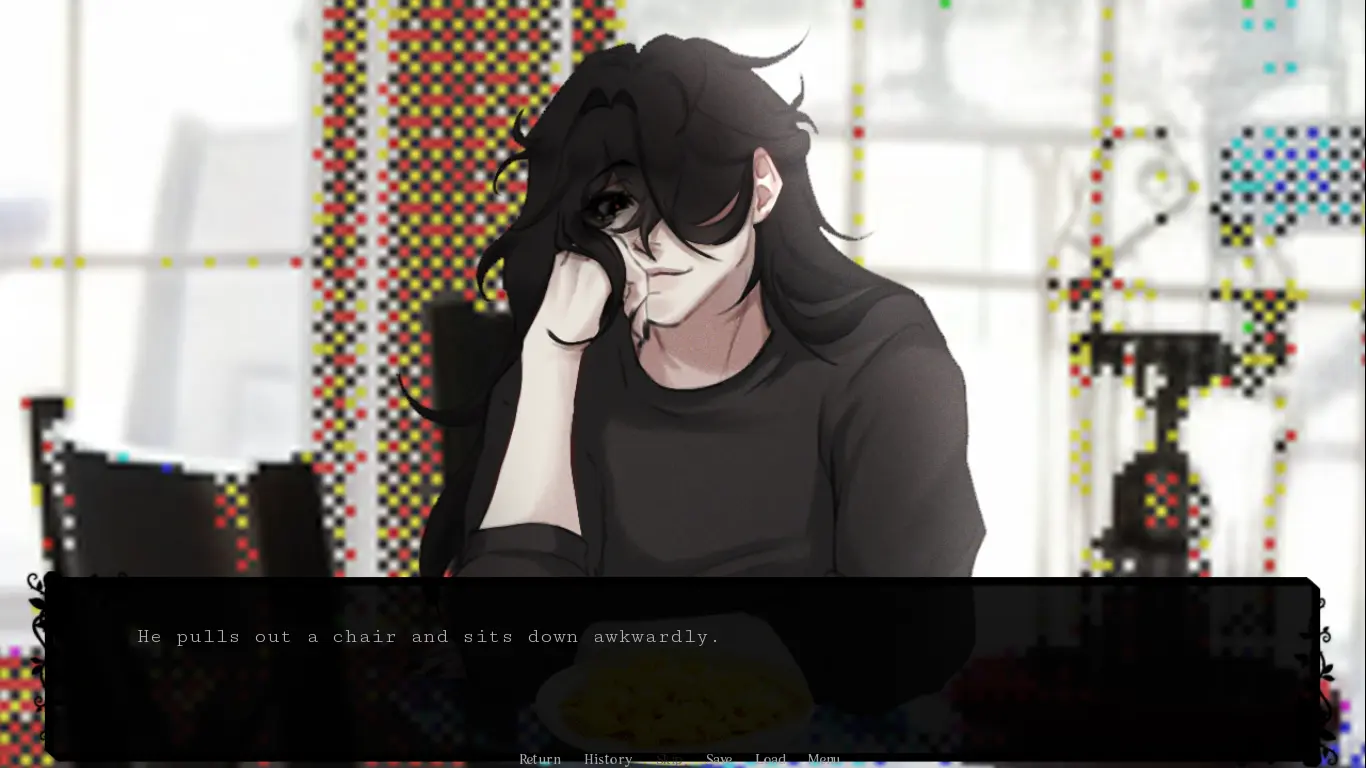
04Awkward gestures and spare narration leave room for the player to decide what kind of relationship is taking shape.
Room evidence · 02
Real game captures selected to show the visual language without explaining the complete story.
How to play · 03
The interaction is approachable. The real work is noticing how objects, wording, and distance between people change the meaning of the house.
Confirm the mature-horror notice and start the browser player. The game is served from a separate host, so the first visit can spend a short time on a dark frame while images, audio, and scripts arrive. Click once inside the player after it appears. That interaction gives the embedded game focus and may also satisfy the browser rule that prevents sound from starting automatically.
Follow the on-screen interface and give each line enough time to sit beside the image. The game communicates through restrained narration and visual composition. A character standing naturally in a bedroom may be more significant than a dramatic effect, while a common household object can become uncomfortable because of the choice attached to it. Speed makes those relationships easy to miss.
When the game presents a response, read the available language as part of the scene rather than a conventional success test. A choice can reveal what the player character is willing to tolerate, question, keep, discard, or consume. Select the answer that fits your current understanding. The tension works because the house does not provide enough certainty to guarantee emotional safety.
If you return, pay attention to the image before the choice appears. Look at what is placed at the center, which personal object has crossed from one person to another, and how the narration describes simple movement. The game is short enough to support a second reading, and repeated scenes often become more revealing once the initial surprise no longer controls your attention.
Viewing room · 04
Use these source-project video selections for a preview or optional assistance.
Preview the domestic environments, dialogue presentation, and slow pressure of the browser experience.
Consult the longer footage if you want to compare decisions or see how the short narrative develops.
Archive essay · 05
Most stories about an unsafe home begin with a boundary being broken. A door is forced, a window is found open, or an unknown sound proves that an outsider has crossed into private space. Home Is Where He Is takes a more intimate route. The disturbing figure does not need to look lost. He can sit, wait, wear something familiar, and occupy the composition as if the room has always included him. The problem is not only intrusion. It is the possibility that the house has already reorganized itself around his presence.
This distinction matters because trespass leaves the resident with a clear moral map. The outsider is in the wrong place, and restoring safety should mean removing him. Possession is harder to name. A person who appears comfortable among personal objects can create uncertainty about whose definition of home now counts. The environment offers evidence of intimacy without explaining whether that intimacy was welcomed. Instead of asking whether he is physically present, the game asks what his ease implies.
The screenshots show a bright kitchen, a furnished bedroom, and a dining space that could belong to countless houses. These rooms are persuasive because they are visually ordinary. Cabinets, photographs, patterned furniture, and daylight create a documentary layer beneath the illustrated character. The combination makes him seem inserted into a place that existed before the story began. At the same time, his designed stillness commands attention, so the eye can never treat him as just another household detail.
Small objects become especially powerful in that setting. A sweater is not a weapon. It is soft, useful, and close to the body; it carries the shape and scent of its owner. Seeing another person wear it can suggest affection, permission, carelessness, theft, or a relationship whose terms have become unclear. The narration does not need to announce danger. One sentence about the sweater gives the player enough information to feel that a private boundary has been converted into a fact.
The apple choice works in a similar way. Food is part of the daily grammar of home: keep it, eat it, discard it. Placing those actions on the screen makes routine feel ceremonial. The player is asked to declare how the object should be treated, and each option can sound more consequential than its literal result. Horror enters through framing. Once an ordinary item has been selected as meaningful, the kitchen stops functioning as neutral scenery.
Character horror often relies on a visibly monstrous transformation. Here, the available art is effective because the figure remains recognizably human. His long dark hair, loose clothing, tired expression, and contained gestures can read as vulnerable in one image and invasive in another. The ambiguity makes the player responsible for interpreting distance. Is he waiting to be understood, assuming a closeness, or using softness to make resistance feel cruel?
The game does not need to settle that question immediately. Uncertainty keeps the domestic situation active. If he appeared entirely threatening, every object associated with him would have one meaning. If he appeared entirely safe, the title would lose its pressure. Instead, the phrase “Home Is Where He Is” sounds almost affectionate until the player considers who must rearrange their life for it to be true. A comforting proverb becomes a rule authored by somebody else.
This is why the title does more than identify a location. “Home” is normally chosen by memory, attachment, routine, and control over private space. “Where he is” replaces those conditions with a person. The statement follows him rather than the resident, making his presence the fixed point around which safety must be recalculated. The grammar is simple, but the transfer of authority is severe.
A compact game cannot spend hours building a complete biography of every room. Home Is Where He Is turns that limit into an advantage. It selects a handful of recognizable domestic signs and lets the player supply the history that would make them personal. Because most people understand the emotional function of a bedroom or dining table, the game can reach vulnerability quickly. It does not need to explain why a private garment matters or why awkward silence across a table feels exposing.
Short horror also prevents familiarity from becoming routine for the audience. Each scene can arrive as a concentrated image, establish one troubling relation, and leave before repetition makes it harmless. The result resembles a sequence of remembered fragments rather than a complete architectural tour. The player is not given the comfort of mapping every corridor. Instead, the house exists through emotionally charged rooms.
The visible options in the kitchen suggest that interaction is not about mastering a complicated control system. It is about deciding what response belongs to you. Throwing something away, leaving it untouched, or consuming it can each express a boundary, even when the immediate object seems harmless. The menu slows the moment down and forces a private reaction into explicit language.
That process is especially appropriate for domestic horror. Homes are governed by countless choices that usually remain invisible: who may enter, who can touch personal things, what must be kept, and which behavior is considered normal. When those rules are shared, the house feels easy. When they are imposed, every ordinary action becomes negotiation. The game makes selected negotiations visible so the player can feel the structure underneath the rooms.
The character art allows room for sympathy. An uneasy expression or awkward posture can invite care at the same time that the surrounding context produces alarm. Mature psychological horror is often strongest when vulnerability does not automatically equal innocence and discomfort does not automatically equal guilt. People can need connection while crossing boundaries; a scene can be tender and unsafe at once.
Players should therefore resist reducing the figure to a single label before the story has spoken. Observe what the images and narration actually provide. The goal is not to excuse every implication, but to notice how quickly appearance can recruit the player into one interpretation. Home Is Where He Is uses that hesitation as its central atmosphere. The house is frightening because it contains a relationship that looks partly established and partly impossible.
For readers who enjoy story-led indie horror, this makes the browser game a focused exercise in emotional framing. It does not require a vast map or constant danger to make the screen feel close. A room, a person, an object, and one line of text can be sufficient. The player supplies the boundary, and the scene tests whether that boundary still has authority.
Practical notes · 06
The game itself is embedded from a dedicated host rather than packaged inside the surrounding article. This separation keeps the portal light, but it also means the player and the page can finish loading at different times. On a first visit, wait while the game host transfers its assets. A black frame is not immediate proof of failure. Click once to give it focus, allow a reasonable interval, and avoid repeated refreshes that restart the same download.
If the frame never changes, test the simplest causes first. Update the browser, permit scripts and cross-site game resources, and temporarily disable an aggressive blocker for the game host. School, office, and filtered public networks sometimes allow the main website while rejecting the separate host. Trying another connection can distinguish a network restriction from a game problem.
Desktop Chrome, Edge, or Firefox provides the most predictable presentation. Close memory-heavy tabs if animation or input becomes sluggish. The fullscreen button beneath the frame expands the entire player; press Escape to leave it. Fullscreen may fail when the browser has blocked the permission or another page element is already using that mode.
Mobile devices may load the experience, but a landscape tablet or desktop is more comfortable. The images use a wide format, and the visual-novel interface places text and navigation near the lower edge. On a narrow phone, browser controls and touch gestures can compete with the game. Rotate the device before launching and avoid swiping from the screen edge while selecting an option.
Sound commonly remains muted until the first deliberate interaction. Click inside the player, check the tab icon, and confirm the operating system is sending audio to the intended speaker or headphones. Save availability is controlled by the embedded game and browser storage. Use the same profile when returning, because private mode, automatic cleanup, or clearing site data can remove local information that this portal cannot restore.
The story is presented for mature horror audiences. Its discomfort centers on private boundaries, an intrusive or difficult-to-read presence, and the emotional uncertainty of a home that no longer feels fully controlled. The images on this page provide a measured preview, but personal reactions vary. Pause, leave fullscreen, or stop entirely if the material reaches a boundary you do not want to explore. Horror is an invitation, not an obligation.
Questions · 07
Direct answers about format, devices, loading, and content with minimal spoilers.
Yes. Select Enter the House to load the browser edition inside the player. It runs from the dedicated game host, so there is no separate installer or account requirement.
It is a compact psychological browser horror experience with visual-novel presentation. The game uses domestic rooms, character art, written narration, and occasional choices to make an apparently familiar home feel increasingly unsafe.
No. The available scenes present a story-led experience rather than a reflex challenge. Read the text, observe the changing character and room details, and respond when the interface offers a choice.
It is best approached as a short, focused indie horror session. Exact play time varies with reading speed and whether you pause to examine scenes or revisit decisions.
A current mobile browser may display the game, but desktop or a landscape tablet is recommended. The wider frame keeps the dialogue, character artwork, choice buttons, and lower navigation controls easier to read.
Allow the first load time to download its assets, then click inside the frame. If it remains black, refresh once, disable aggressive content blockers for the game host, and try an updated Chrome, Edge, or Firefox browser.
Most browsers prevent embedded media from playing audio before a visitor interacts with it. Click or tap inside the player, make sure the tab is not muted, and check the device output volume.
Any save behavior is controlled by the game and the storage available to its host. Return with the same browser profile, and avoid private browsing or clearing site data if you want locally stored progress to remain available.
This portal presents it as a mature psychological horror experience. Its themes include an intrusive presence, loss of safety, disturbing relationship implications, and intense unease, so it is not intended for children.
No. This is an independent browser-game archive and discovery page. The game, title, characters, artwork, and other intellectual property belong to their respective creator or rights holders.