 01
01Read the whole lane
Locate the cat, flag, hazards, broad walls, and one safe stopping point before choosing force.
THE FAIRWAY IS ODD; THE ANGLE IS STILL REAL
Features uncanny faces, flashing meme-style imagery, and intentionally chaotic visual humor.Archive game / Surreal mini golf
Aim a square cat across strange top-down fairways where clean bank-shot geometry shares the course with meme props, smiling hazards, water, sand, and visual nonsense.










Course briefing / 01
Uncanny Cat Golf Uncanny Cat Golf begins with a rule that needs no explanation: move the ball into the cup with as few strokes as possible. The complication is that the ball is a square cat, the clubhouse display looks borrowed from an aging computer, and every new hole seems more willing to decorate ordinary mini-golf with faces, balloons, water, sand, signs, and objects that do not belong to the same visual universe. The game is funny immediately, but it remains playable because angle, power, collision, momentum, and par never stop mattering.
This Temple of the Jackal archive edition treats each course like a recovered mechanism. A hole can look chaotic while still offering a readable sequence of safe zones, flat banks, narrow gates, and final approaches. Launch the browser build above, click inside the frame, and give the remote files time to initialize. The best first round is not the fastest. It is the one where every miss teaches how far the cat travels, how sharply it rebounds, and which decorations are real obstacles rather than visual distractions.
01Locate the cat, flag, hazards, broad walls, and one safe stopping point before choosing force.
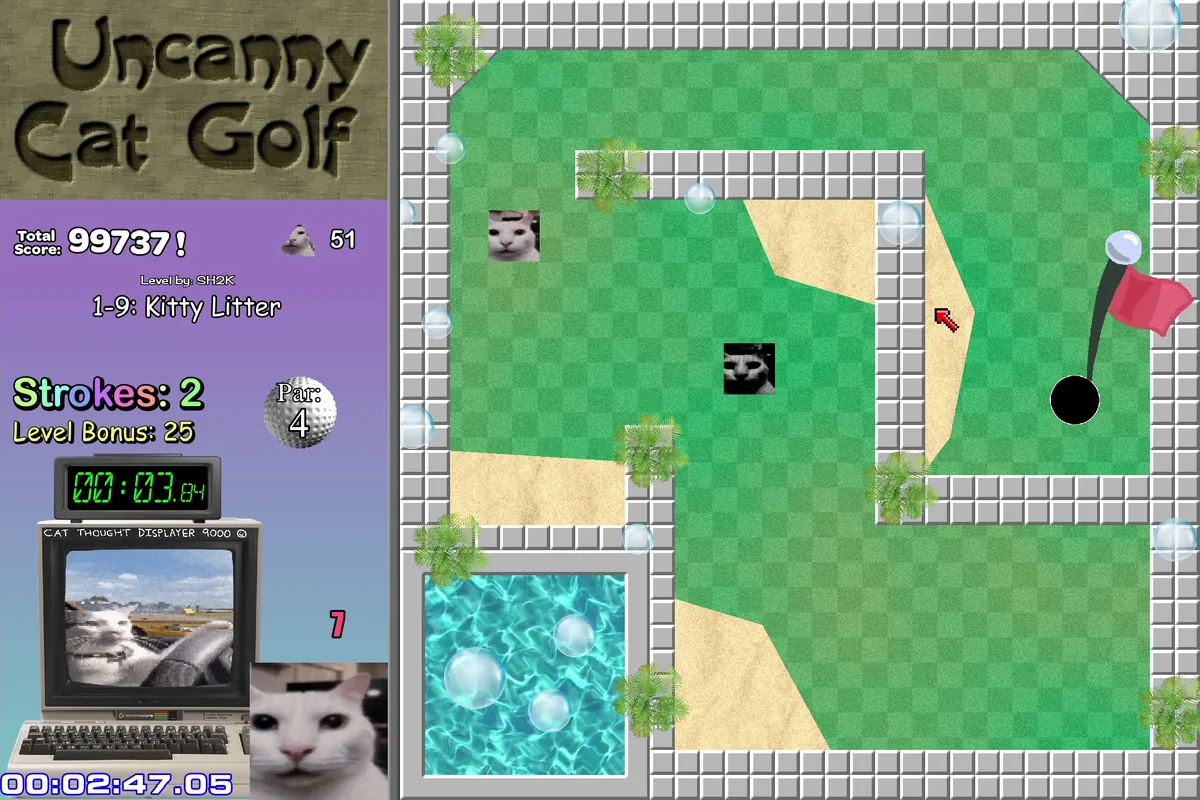 02
02Use large flat surfaces when a direct line is blocked; predictable geometry beats a tiny bumper.
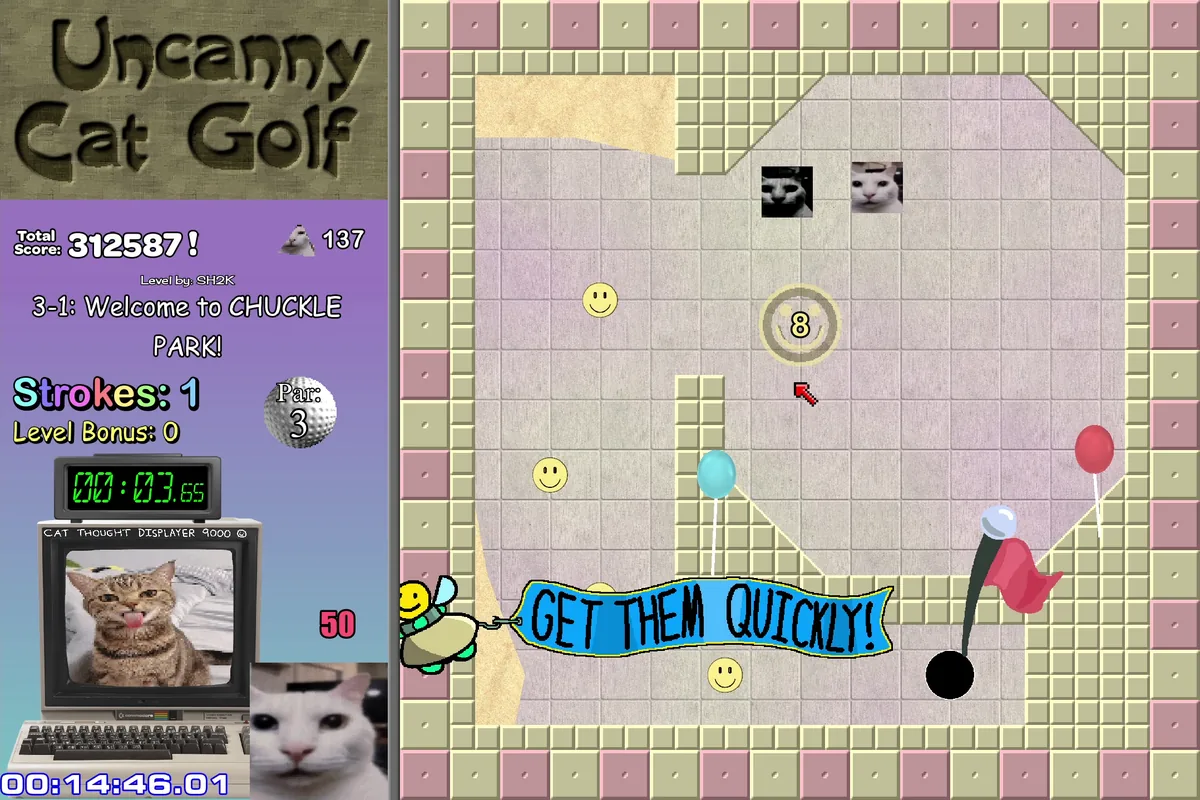 03
03A controlled setup near the cup usually costs less than recovering from an ambitious shortcut.
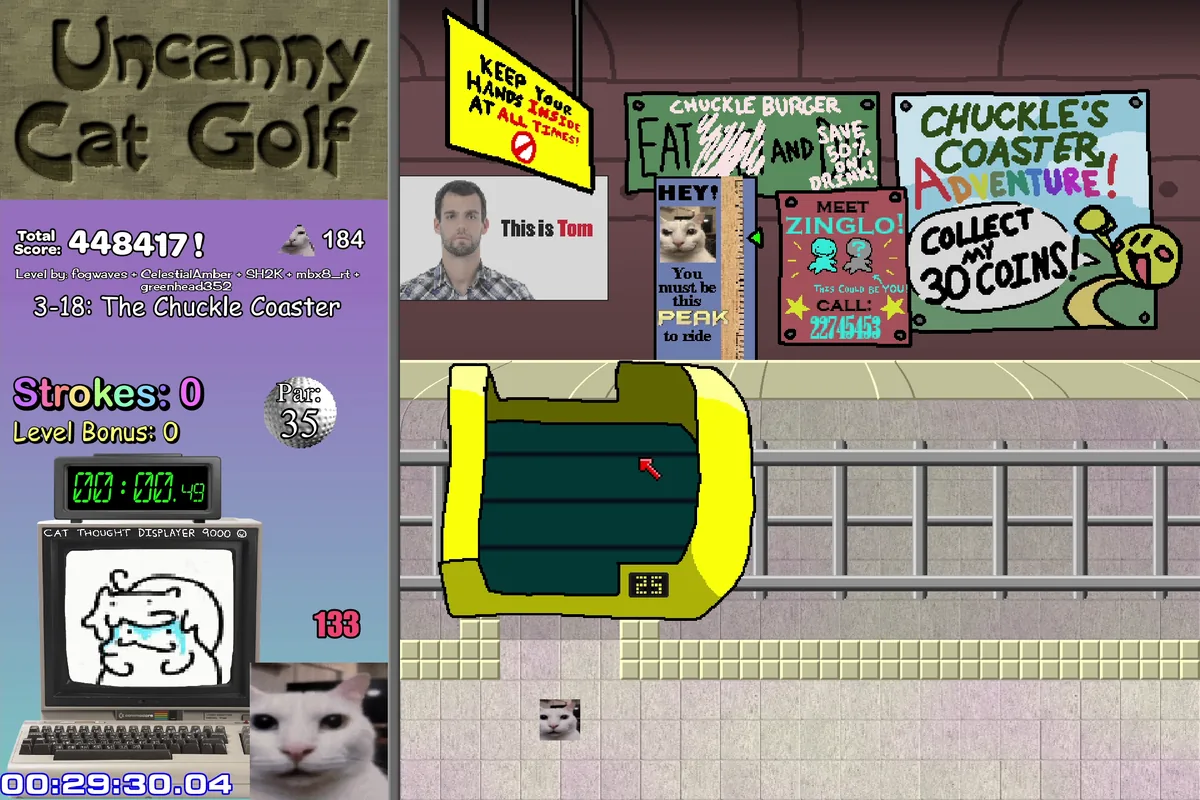 04
04Change only angle or power on a troublesome hole so every attempt produces useful evidence.
Recovered fairways / 02
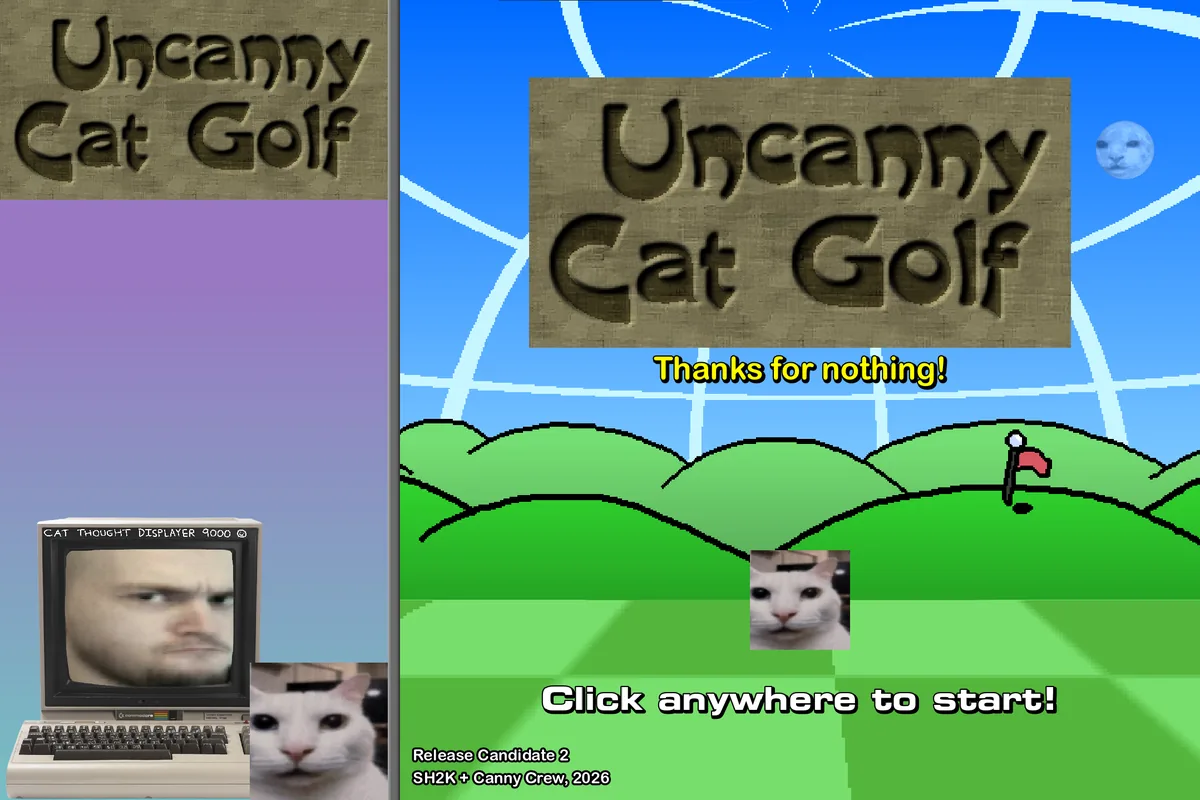
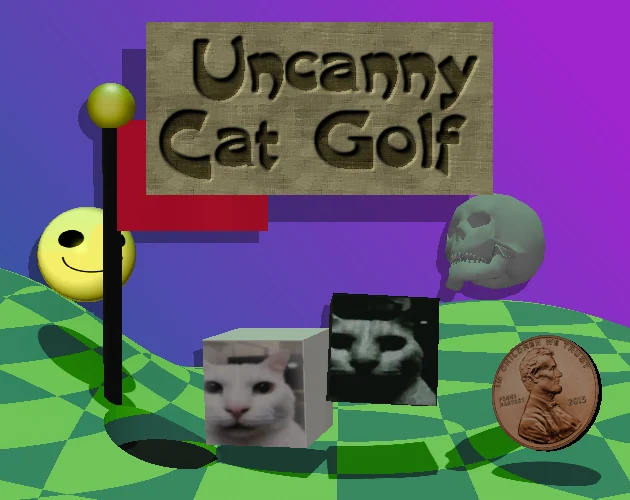
The supplied screenshots show how Uncanny Cat Golf keeps a consistent top-down sports layout while changing the visual language around every route.
Caddie notes / 03
Mini-golf becomes manageable when the player converts one dramatic launch into a chain of deliberate positions.
Find the final clean approach first, then identify the stopping point that can create it.
A large flat bank gives a useful margin for error; tiny bumpers multiply uncertainty.
Water and sand can turn a one-stroke gamble into several recovery attempts.
Distance and rebound are measurements. Adjust one input instead of repeating the same miss.
Screening room / 04
The two videos provide motion and timing context without replacing the playable browser frame.
See how aiming, power, cat movement, score information, and early obstacles fit together.
Preview later visual themes, bank opportunities, and the escalating collage humor.
Course essay / 05
Replacing a golf ball with a square cat creates immediate comedy because the object looks unsuited to rolling, yet the game still treats its movement consistently enough to support planning. The player quickly stops asking whether the cat should behave like sports equipment and starts measuring where it will stop. That transition is important: a visual absurdity becomes a trustworthy mechanical object through repetition.
The cat also makes failure memorable. A conventional ball resting in the wrong corner is merely inconvenient; a flat-faced cat stranded beside a smiling obstacle becomes a tiny scene. Humor softens repetition without removing consequence. Players can laugh at a disastrous result and still understand exactly why the stroke damaged par.
The score panel provides a stable language across courses. Strokes, par, time, level, and bonuses tell the player what progress means even when the scenery changes from green maze to tiled park or amusement corridor. Without those numbers, the game could feel like a sequence of interactive jokes. With them, every strange hole becomes a comparable sporting problem.
Par should be treated as a second objective rather than a demand for perfection on the first visit. Completing a hole reveals its actual distances and collision behavior. Optimization becomes fair after the route is known. A high score is not wasted time because it records the places where confidence outran information.
Most mini-golf hazards announce themselves through shape: a wall blocks, water punishes, sand slows, and a moving obstacle changes timing. Uncanny Cat Golf surrounds those functional objects with imagery that may be decorative, comic, or deliberately distracting. The player must classify the scene before solving it. Attention becomes a resource alongside strokes.
A useful scan separates route geometry from atmosphere. First identify boundaries and surfaces that affect movement. Then notice gates, corners, and possible banks. Only after that should the player enjoy the faces, signs, monitors, balloons, and visual non sequiturs. This order prevents a loud joke from hiding the simple lane beside it.
A full-power shot feels efficient because the cat covers distance quickly, but distance alone does not create progress. Momentum can carry the cat beyond a useful opening, across a hazard boundary, or into a corner where the flag is no longer visible. The following strokes then pay for speed that never served the route.
Controlled power preserves options. A planned stop near the entrance to a narrow section can make the next putt simple, while an aggressive attempt to cross everything at once depends on several perfect collisions. The best score often comes from respecting the second shot before taking the first.
Walls are not merely restrictions. A flat surface can redirect the cat around a blocked corner and turn an impossible direct line into a repeatable two-part route. Good banking begins by imagining the desired exit direction, then working backward to the contact point. The incoming angle and outgoing angle should feel like one planned gesture.
Large walls are easier to trust than small bumpers because they tolerate minor aiming error. When several banks appear possible, prefer the one that leaves the cat in open space even if the rebound is imperfect. A successful bank should improve position, not only look impressive while it happens.
Crowded holes become less intimidating when divided into places where the cat can stop without touching water, sand, a moving prop, or a dead corner. Each safe zone becomes a temporary tee. Instead of solving the whole course in one prediction, the player solves the next transition and reassesses from the new position.
This method also supports learning. If a shot fails, the missed target is clear. Force can be reduced, an angle widened, or another bank selected. A vague goal such as get near the hole provides less information because many different mistakes can produce the same disappointing distance.
After a costly hole, note the opening plan, total strokes, and worst recovery. Choose one question for the replay: was the first angle wrong, was power excessive, or was the selected bank too small? Keep the other inputs as stable as possible. Controlled comparison turns repetition into analysis rather than frustration.
A better score is satisfying because it proves the course became legible. The scenery remains absurd, but the player now sees a route through it. That change in perception is the real progression of Uncanny Cat Golf: the game does not become less strange; the player becomes better at finding dependable geometry inside the strangeness.
If every hole used the same green felt and grey wall set, strategy could become automatic. New themes force the player to classify surfaces and hazards again. The visual shift restores uncertainty without discarding the learned skills of route scanning, power control, safe stopping, and bank prediction.
The collage style therefore has a mechanical benefit. It refreshes attention. Players cannot assume that the most colorful object is dangerous or that a familiar-looking prop is harmless. Each course asks for a brief pause, and that pause is exactly what good mini-golf planning already requires.
A compact course record can preserve useful evidence between sessions without turning play into accounting. Write down the hole theme, the opening target, the wall or hazard that created trouble, and the total strokes. Four details are enough to reconstruct the important decision. A screenshot can help when the route is visually dense, but the note should describe why a position mattered rather than merely showing where the cat stopped. This creates a practical archive of solved movement problems instead of a gallery of unexplained successes and failures.
Compare records by route quality before comparing final score. One attempt may finish in fewer strokes because an uncontrolled rebound happened to land near the cup, while a slightly slower route may produce the same safe approach repeatedly. The repeatable plan is more valuable for learning. Once its stopping zones and banks are dependable, power can be increased or one setup stroke removed. Optimization should grow from a stable route; otherwise a lower score can hide the fact that the player does not yet understand which part of the shot created the result.
This method also keeps the game's absurd presentation enjoyable. Constant restarting can make every strange face or prop feel like an interruption, while a measured record lets the player accept comic failures as information. The cat stranded beside a bizarre object still creates a memorable scene, but the note translates that scene into a useful next question. Did the shot begin too close to a wall, carry too much speed into a corner, or aim for a space with no recovery lane? Answering one question at a time gives the archive a clear purpose and lets improvement coexist with surprise.
Browser field notes / 06
The primary player loads from s.uncannycatgolf.org. Press the launch button and allow remote scripts, artwork, and audio time to initialize. If the frame is dark, click inside once and wait before refreshing. Repeated reloads can restart a slow transfer. Privacy extensions or managed networks may block the game host while the surrounding page continues to work normally.
Mouse or trackpad play is the clearest way to aim. Click inside the iframe whenever input appears inactive because another page control can take focus away from the game. Fullscreen gives narrow gates and small hazards more space. Exit fullscreen with Escape or the browser control before using the archive navigation.
Modern phones and tablets may run the browser build, but landscape orientation is recommended. Precise aiming can feel less predictable on a small touchscreen, and browser interface bars may reduce the visible course. Desktop play is the safer choice when comparing power or planning a bank with little margin.
Progress and scores may rely on browser-managed storage. Clearing site data, using private mode, switching profiles, or moving to another device can produce a fresh session. Keep a short note of difficult holes and successful approaches if you plan to optimize several courses over multiple visits.
The two YouTube videos load from a different provider than the game. A network may allow one and block the other. Videos can reveal later course themes, so players who want surprise should watch briefly, then enter the playable frame. This archive does not claim ownership of the game, images, or footage.
The supplied public artwork is non-graphic, but the experience uses uncanny faces, flashing meme-style images, and deliberately chaotic humor. Players sensitive to rapid visual changes or unsettling expressions should use a comfortable screen brightness, take breaks, and stop when the presentation is no longer enjoyable.
Questions · 07
Useful answers with minimal spoilers and clear browser guidance.
It is a browser mini-golf game where a square cat replaces the ball and surreal collage-style courses surround familiar aim, power, hazard, score, and par mechanics.
Yes. Press the launch button to open the embedded build hosted at s.uncannycatgolf.org without installing a separate package.
Use a mouse or trackpad to aim and take each shot. Click inside the iframe first if the game does not receive input.
Read the whole hole, choose a safe stopping point, and plan a controlled second shot instead of forcing a hole-in-one.
Yes. Broad flat walls are reliable tools for entering blocked corridors and avoiding direct hazards.
It may run in a modern mobile browser, but landscape orientation and desktop fullscreen provide more precise aiming.
Wait for remote assets, click the frame, refresh once, and check extensions or network filters that block scripts and iframes.
They may depend on local browser storage, so clearing site data, changing profiles, or using private mode can remove progress.
It is mainly surreal comedy mini golf. Uncanny faces and odd imagery create atmosphere, but the supplied public screenshots are not graphic.