Pokemon Survivor replaces a fixed puzzle chamber with an arena that keeps asking new questions. Which direction remains open? Is the active attack suited to the approaching group? Does the next upgrade support a plan or merely add another choice? This Temple of the Jackal archive entry approaches the fan-made PokeSurvivor as a spatial challenge: read the board, preserve an exit, then commit. The browser edition provided by Pokemon Survivor Wiki is solo, with local progression rather than cloud accounts. It is independent fan software, not an official Pokemon service. You do not need original data files or a microphone to begin. You do need to understand the difference between automatic attacks and automatic survival. The first reduces repeated clicking; it does not remove the need to steer, switch, observe, and learn.
The source link opens the game website if embedding fails. This edition is solo; browser storage may be separate across portals. The launch cover is illustrated artwork.
Field note 01
Before crossing the threshold
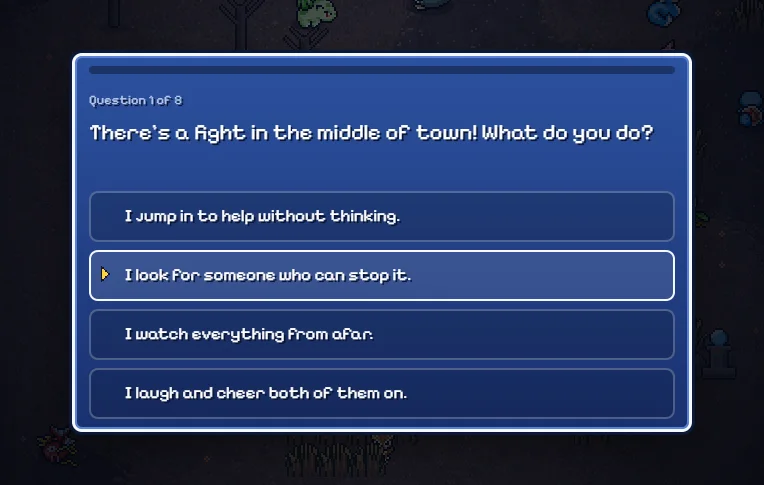
Launch the frame above and allow its resources to load before testing controls. The opening local flow can include a personality questionnaire and a choice of starting partner. Treat that selection as an introduction to a move set, not a promise that every familiar creature is immediately available. The partner affects the starting attack and the legal move pool. If you are following a recording, compare the menus before assuming that its account state matches yours. This hosted edition intentionally disables cloud login and online lobbies. A multiplayer button in a recording from the author's original service does not mean there is a hidden switch on this page. Begin with a small aim: reach the arena, move with confidence, and identify the attack currently in use. Longer-term collection plans can wait until the basic loop feels readable.
The personality questionnaire in the local game opening. Reference interface; browser labels and client versions can differ.
Field note 02
Read the empty parts of the arena
In a puzzle, an empty tile can be as important as a marked one. In this game, open ground provides the time and room needed to respond. Use the arrow keys or WASD to steer, keeping enough space ahead to change direction. Do not assess a route only by the number of pickups visible along it. Ask what happens if another group approaches while you are travelling there. A narrow corridor can make a reward expensive even when the item itself has no price. Terrain and enemy movement both change the useful route. This is a positioning principle, not a guaranteed safe circuit: revisit the plan as the screen changes. If you repeatedly end up trapped, shorten the distance you commit to before reassessing rather than simply trying to execute the same long path faster.
Field note 03
The weapon is a stance you select
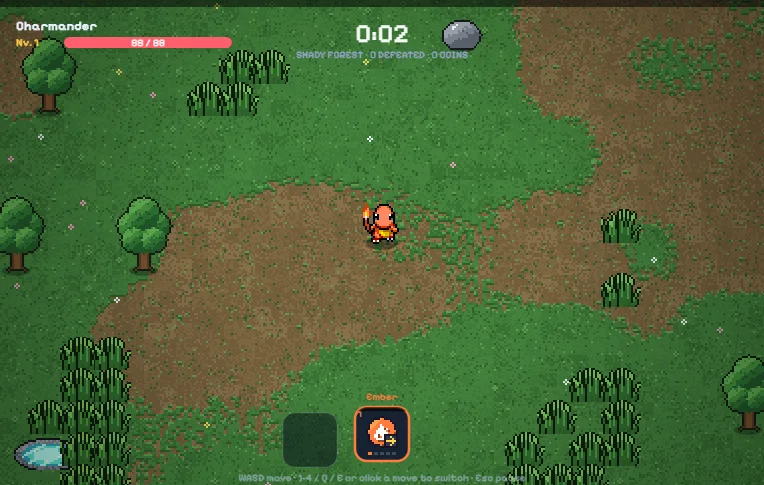
The active move fires automatically. That fact is useful only if you know which move is active and where it works best. Ordinary slots are not four weapons attacking together. Select them with keys 1 through 4, or cycle using Q and E. On a touch device, tap the move icons at the bottom. Think of switching as changing your stance: it can change which position is comfortable, which group you can approach, and how much distance you should preserve. Test a new option while you still have room to retreat. Legendary bonds can later combine moves in a slot, but they are a separate mechanic. Do not use their existence to assume an ordinary four-slot setup already has that behaviour. The reliable first check when damage seems wrong is the active slot, not a new purchase.
An arena run with the move bar and nearby enemies. Reference interface; browser labels and client versions can differ.
Field note 04
Pick up experience without surrendering the route
Experience gives access to level-up choices, so collecting it matters. The route to it matters too. Look at the nearest safe approach, the space beyond the pickup, and the direction from which enemies are arriving. A collection path that ends with no room to turn may cost more than the level it helps earn. Rather than chasing each new object individually, choose a route that lets you gather several while retaining an exit. This does not require memorising an optimal map or calculating a fictional score. It is a way to reduce unnecessary reversals. When a run fails, ask whether the fatal movement was an attack decision or a collection decision. That distinction suggests a useful next experiment: keep the same partner and moves, but change how aggressively you cross crowded ground for experience.
Field note 05
Upgrade choices have different jobs
A level-up card can add a move, raise a move's level, or grant a run-specific stat improvement. Read those categories separately. More options are not always better than developing the one that already fits your movement. Conversely, improving an attack you cannot use safely may leave the main problem untouched. A partner's types and the Normal pool determine the ordinary legal move pool in this release. Do not import assumptions from a different Pokemon game's learnset. Before selecting, name the problem you want the card to solve: reach, control comfort, development toward evolution, or another clearly observed need. This is more useful than labelling every unfamiliar card good or bad in isolation. A draft can be legal without being easy to operate, and this guide does not present untested combinations as a proven tier list.
Field note 06
Solve evolution as a two-part condition
An evolvable move needs its own level cap and the corresponding run stat card. These conditions belong to the current attempt. A permanent upgrade in the menu may have a familiar name, but it does not satisfy the run-card requirement. The source rules pair Ember with Power and Bubble with Sprint; check the actual entry for other moves instead of generalising either example. A qualifying card taken earlier in the same run still works. Move evolution is also not species evolution: these are different ideas even when the word sounds familiar. Buff moves do not have evolutions in this release. When several moves qualify, an offer can prioritise the first eligible option, so eligibility is not a promise that every move transforms at the next level. Read what is offered and keep the rest of the plan flexible.
Field note 07
Recognise a threshold before stepping through it
Rifts are portals into separate legendary arenas, not another name for ordinary bosses. A scheduled boss does not guarantee a rift on demand. Before entering a portal, check health, the selected move, and whether you understand the range you intend to use. The source documents a timed legendary encounter, so spending the first part of it discovering controls makes the challenge harder for reasons unrelated to the build. Watch warning areas on the ground and make space before their effects resolve. A victory can award a bond, which changes move-slot combinations and deserves a careful reading of its own. These notes explain preparation and distinctions; they do not guarantee a clear or invent a route that avoids every attack. Treat an unfamiliar arena as a new spatial problem rather than an automatic reward.
Field note 08
Return to camp with useful information
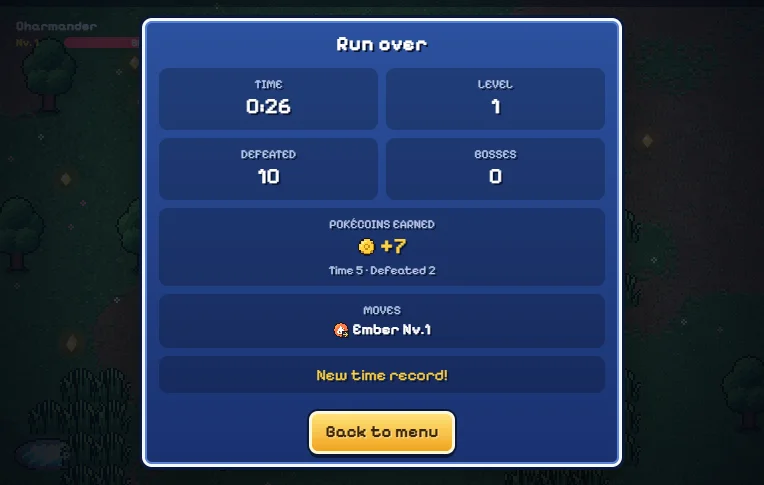
The result screen is an opportunity to decide what the attempt taught you. Persistent collection and progression can be saved locally when storage is available, while a live unfinished battle is not preserved for resuming after reload. Separate what belongs to the attempt from what belongs to the menu. Temporary move levels and run cards are not permanent partner upgrades. After a short run, inspect the actual changes instead of assuming every displayed number carries forward. A practical note might be that you switched too late, entered a portal unprepared, or collected experience through an unsafe gap. One observation is enough to give the next attempt a purpose. Changing every part of the setup immediately makes it harder to tell whether the improvement came from movement, card selection, or a different partner.
The run result interface used to review a completed attempt. Reference interface; browser labels and client versions can differ.
Field note 09
Read the collection rules before spending tickets
Regional banners use tickets earned in play. The local release does not sell them. Each region tracks its own pity, so a total assembled from different banners is not a shared guarantee. The documented seventy-count condition guarantees five-star rarity on that banner, not a named species. Getting a five-star result resets its counter. A ten-pull guarantee is likewise a rarity rule rather than a promise to fill a particular empty collection slot. Keep those distinctions visible when planning. The goal is to understand the available system, not to encourage chasing a result with money or to imply that a random reward is due because the last few were disappointing. Pikachu and Eevee are collection unlocks here rather than the default answer to every starter choice. Use what the current save actually makes available.
Field note 10
Keep the expedition recoverable
Stay with the same website and browser profile for continuing local progress. Embedded storage can be partitioned by the surrounding website, and the game host is separate from the main wiki domain. A save made elsewhere may therefore not appear here automatically. Do not clear all site data as a first loading fix, because that may remove the progress you wanted to recover. On a phone, try landscape and test drag movement plus tapping move slots before a long session. Fullscreen may provide more room, but it cannot guarantee orientation locking or identical performance across devices. Pause with Esc or P, or the touch pause control, when you need a break. The videos below are references, not proof that every feature shown belongs to this local revision. Watch them between attempts rather than dividing attention during a crowded encounter.
Field note 11
Choose a measurable practice goal
For the next attempt, choose a single test: avoid reversing into crowds, verify every active-slot change, or complete one evolution requirement deliberately. A clear goal makes even an unsuccessful run informative. Keep the partner unchanged for that comparison so a different starting move does not hide the effect of your decision.
Pokemon Survivor gameplay videos
Reference recordings may show a different version or progression. This embedded edition is solo.
Practical questions
Before your next run
01Is this a turn-based Pokemon battle?+
No. It is real-time survival with automatic attacks from the active move. Movement and upgrade decisions remain under your control.
02Does this page require a microphone?+
No. Use keyboard movement and move-selection keys, or the game's touch controls.
03Can all four moves fire together?+
Not in an ordinary unbonded setup. Choose the active slot; bonds later introduce separate combination rules.
04Is a permanent Power upgrade enough for Ember evolution?+
No. The documented requirement is the matching card in the current run plus the move's own level cap.
05Will a boss always open a rift?+
No. Boss encounters and rift portals are distinct events. Do not plan around a guaranteed portal after each boss.
06Can I continue the same battle tomorrow?+
An unfinished battle is not a resumable local snapshot. Collection and other persistent progression are different from a running attempt.
07Are the cover and guide images all screenshots?+
No. The launch cover is an illustration; the partner, arena and result images are captures of the local interface.
08Why should I avoid clearing browser storage?+
The hosted edition keeps local progress there when available. Clearing it can remove collection data rather than merely refresh the picture.
Fan-made PokeSurvivor by JPTER78. Pokemon assets belong to their respective owners. Game and sprite credits.